01.
Alignment
"Every AI tool reads the same decisions. Same context. Same answer — across every chat."
Aligned execution across every chat — Claude, Cowork, Cursor.
The Alignmink Decision Trace Protocol is an open JSON standard. Capture a decision once in any AI chat. Every future conversation reads the same context. Same answer in every tool. Contradictions surface before they ship.
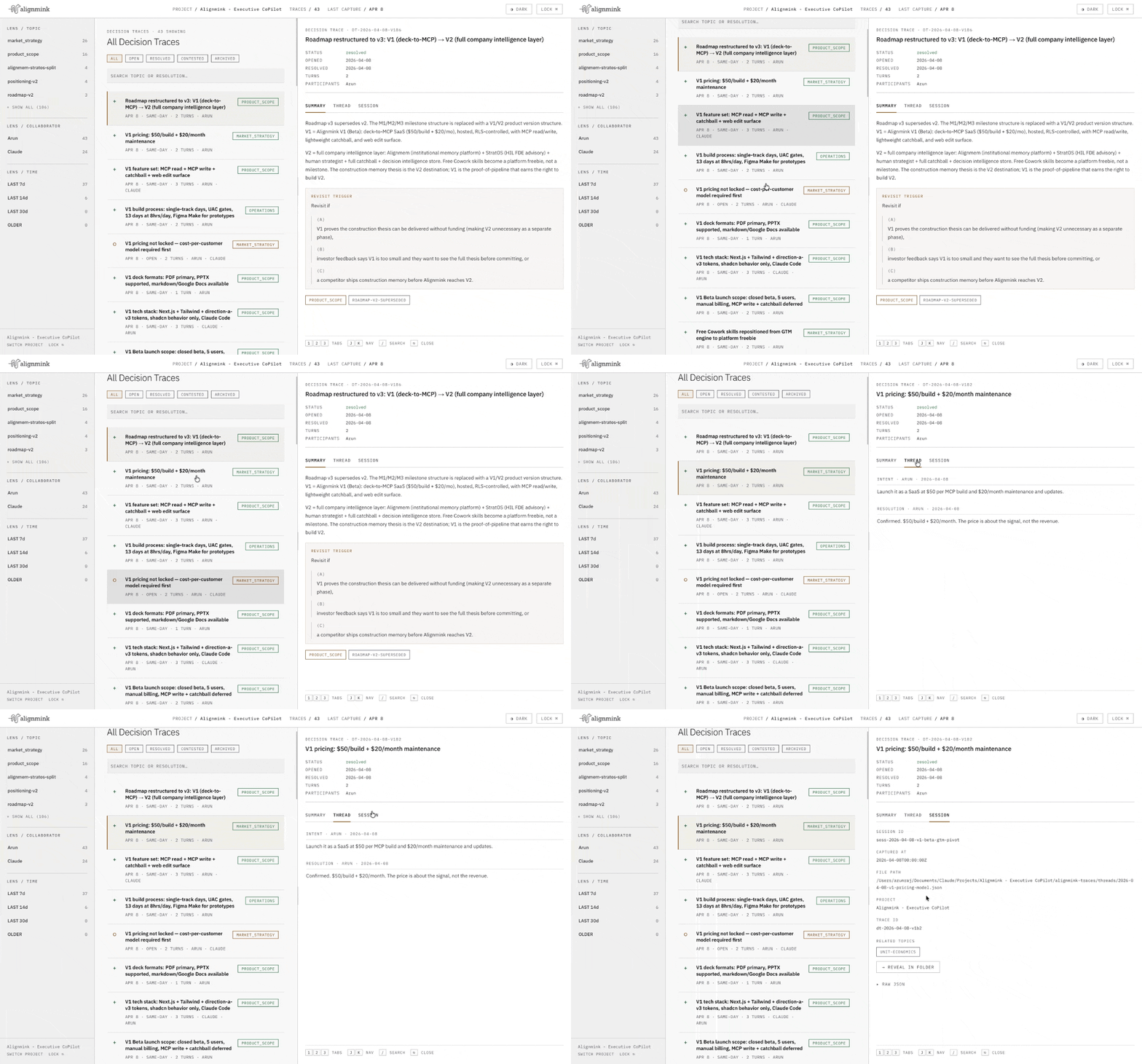
Two steps, under two minutes. The capture skill goes wherever you reason; the journal runs locally on your machine.
Copies the capture skill to ~/.claude/skills/alignmink-dtp/. Silent mid-conversation capture — Claude detects decision moments and writes traces to disk without interrupting your flow.
Opens localhost:3000. Set a passcode on first run. That's it.
Or build from source — github.com/rajconnects/alignmink-dtp. Apache 2.0.
"Every AI tool reads the same decisions. Same context. Same answer — across every chat."
"Catch contradictions before they ship. The protocol surfaces when a new call conflicts with a prior one."
"Your reasoning is your IP — not your vendor's session log. Open format. On your disk. Yours forever."
"The next exec inherits why, not just what. New hires onboard against your captured decisions."
"Past decisions, one query away — by you, or by your AI."
Once captured, your decision traces feed back into every AI conversation. Claude, Cursor, and Cowork reference the same prior calls when reasoning about new work — and surface contradictions when a new direction conflicts with one you've already locked.
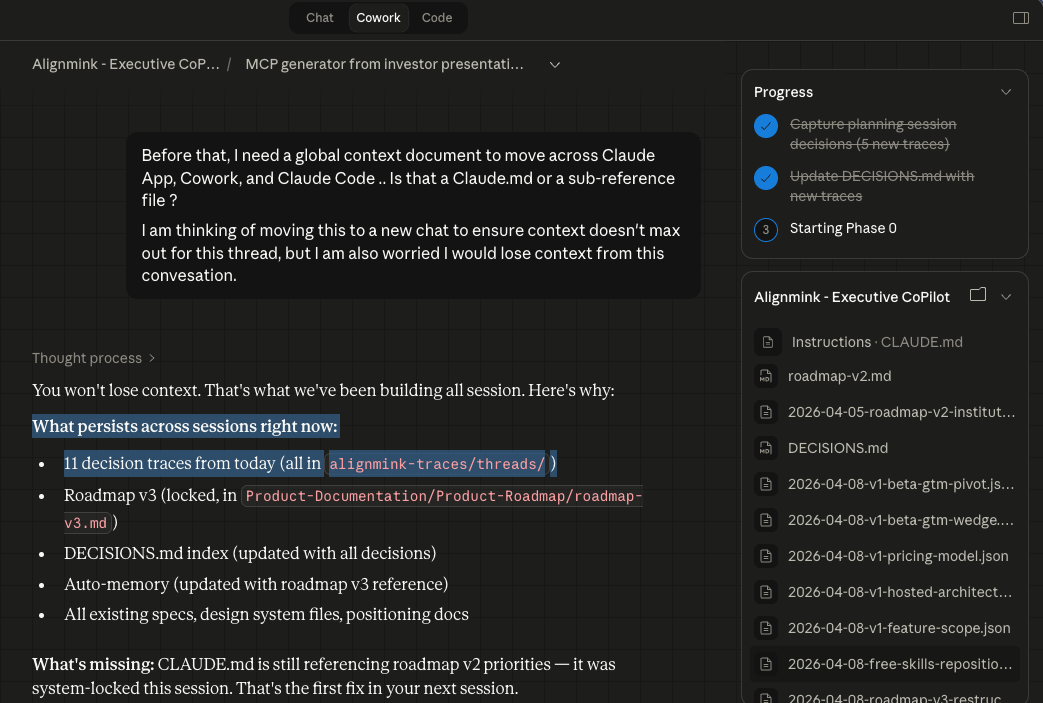
One decision. Every AI tool. Same answer.
Claude prompts when you decide. The JSON lands on your disk — no copy-paste, no extra step.
Across any AI tool — Claude, Cursor, Cowork — every conversation reads the same captures.
Execution stays consistent with what you've already decided. Contradictions surface before they ship.
More decisions are made in chat. Fewer are remembered across them.
Ephemeral by design. Chat windows expire. Reasoning goes with them.
No tool-to-tool memory. Claude doesn't know what you decided in ChatGPT. Cursor doesn't know what Claude resolved.
One open format. Every DTP-compatible reader works with your traces — today and in five years.
One command installs the skill into ~/.claude/skills/. Claude now knows how to detect decision moments mid-conversation.
When you make a decision, Claude asks: "Should I capture this as a decision trace?" One yes, and the JSON lands under ~/alignmink-traces/.
Every future Claude, Cursor, or Cowork conversation reads from your traces. Run alignmink-dtp start and open localhost:3000 to read them yourself — but the AI is already using them.
A memory framework designed to capture the essence of leadership decisions — and an open standard you can read, implement, and extend.
A structured, portable record of a single decision — what you chose, what else was on the table, why, and what would change your mind.
{
  "trace_id": "2026-04-30-pricing-staged-beta",
  "title":    "Stage V1 pricing — $50 beta → $100 launch",           ← what you're calling it
  "decision": {
    "statement":    "V1 ships at $50/mo for 5 users; $100 + $20/user at launch.",  ← what you chose
    "alternatives": [
      { "option": "Single $50/build + $20/mo recurring",
        "rejected_because": "Doesn't capture ongoing value once compile is recurring." }   ← what else
    ]
  },
  "revisit_triggers": [
    "If churn at $100 exceeds 30%.",
    "If a competitor lands at <$50/mo with comparable depth."          ← changes the call
  ]
}
You never write the JSON. The capture skill prompts you mid-conversation; Claude writes the file. Apache 2.0. JSON Schema 2020-12. Your traces work with any DTP-compatible reader, today or in five years.
Aligned execution across every AI tool you use.